
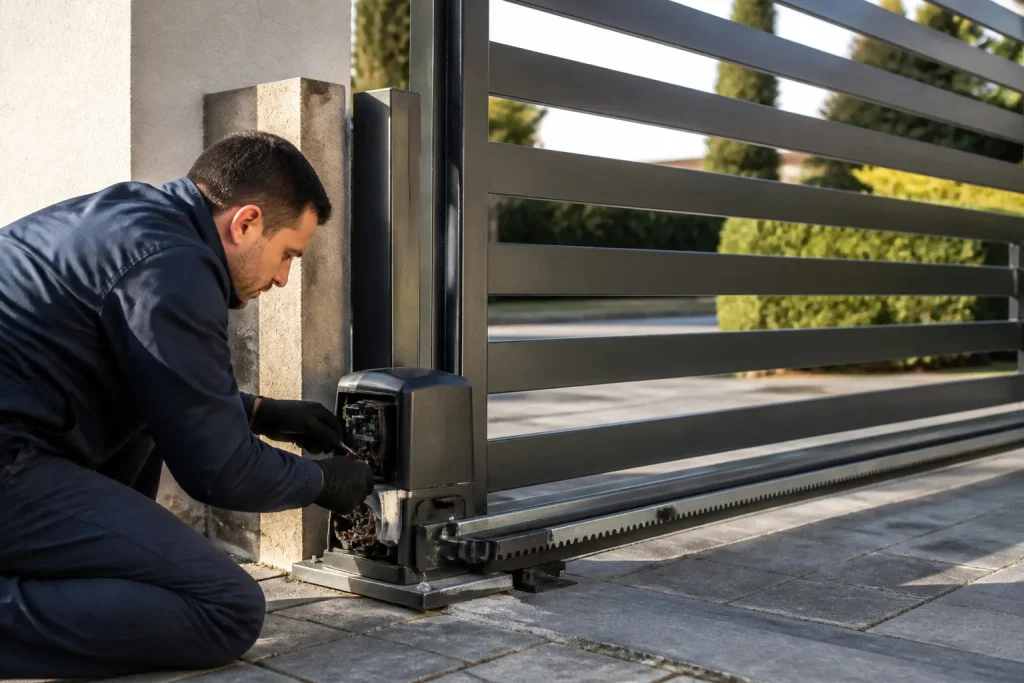
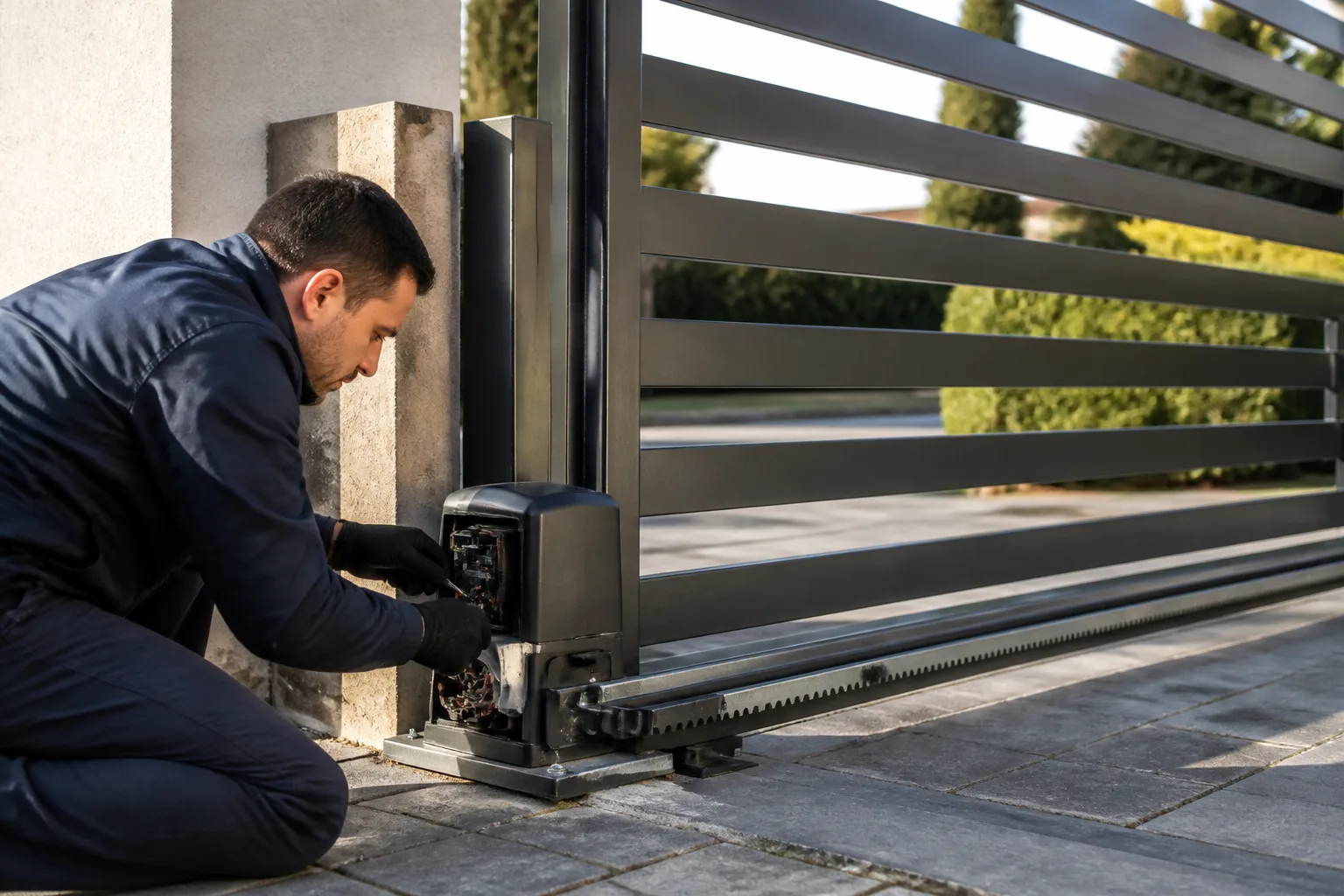
BFT Gate Repair in Lake View Terrace: A Homeowner’s Guide
BFT gate repair in Lake View Terrace usually comes down to one thing the operator manual won’t tell you: most failures that get diagnosed as “bad motor” are actually encoder faults, board settings, or wiring issues that cost a few hundred dollars less to fix. A BFT PHOBOS or IGEA brought in for motor replacement by a generalist often ends up back on its post with the original motor still in it, because the real problem was a $40 encoder disk, not a $300 drive unit. That’s the difference between knowing BFT as a brand and actually working on BFT logic. If you’d rather not get into DIP switches and limit cams yourself, call Gate Repair in Lake View Terrace at (833) 696-4511 and we’ll sort it out.
Key Takeaways
- BFT operators rarely fail at the motor. Encoder feedback, control board configuration, and accessory wiring account for most repair calls we see across Lake View Terrace driveways.
- The IGEA and PHOBOS residential lines use encoder-based obstacle detection, and Southern California power events can scramble the settings that keep them running true.
- DIP switch recalibration on most BFT boards takes a technician minutes. Paying for a full board swap without checking switch positions first is a common overtreatment.
- BFT commercial operators (KUSTOS, VIRGO) are a different animal than the PHOBOS or IGEA. A technician who treats them the same way creates repeat problems.
- Ask any gate technician two questions before they touch a BFT: “Which encoder version is on this unit?” and “Have you re-read the DIP bank before condemning the board?” If they blink, call someone else.
Why BFT Gates Fail in Lake View Terrace (And It’s Almost Never the Motor)
We’ve pulled BFT operators out of driveways all over Lake View Terrace, from the streets north of Foothill Boulevard down toward the Hansen Dam side, and the pattern holds: homeowners call expecting a motor replacement, and the failure is in the feedback loop or the board logic. BFT builds operators to tighter tolerances than most residential brands, so the drive units themselves rarely burn out. What does happen, especially in this part of the San Fernando Valley, is heat cycling and power surge damage that affects the encoder system rather than the windings.
BFT’s encoder-based obstacle detection reads motor shaft position continuously and compares it against expected travel. When a gate hits resistance, the encoder signal drops, and the board reads that as an obstruction, reversing the gate. After a SoCal grid event or a rolling brownout, that reference point can drift. The gate starts stopping halfway, or reversing for no visible reason, and the homeowner hears the motor humming fine the whole time. The motor isn’t dead. The board is just working with a corrupted reference signal. A gate specialist who works on Electric Gate Repair in Lake View Terrace sees this exact failure weekly. A generalist sees it and quotes a new motor.
What makes BFT worth understanding is that the fix for this is often recalibration, not replacement. The PHOBOS and IGEA boards allow travel and torque limit adjustment through an onboard DIP bank, no dealer laptop required. A technician who knows the BFT switch map can reset travel limits, re-teach the encoder, and verify torque sensitivity in under an hour. That’s not an insult to the brand, it’s the reason the brand survives in commercial installations that run thousands of cycles a month.
What the DIP Switches Actually Control (And How to Recalibrate a BFT Without Dealer Access)
Every BFT control board carries a bank of DIP switches and potentiometers that configure how the operator behaves. On the residential IGEA line, the first switches set motor direction and gate type, the middle ones set auto-close timing and obstacle sensitivity, and the final ones govern encoder feedback and travel memory. On the PHOBOS, the layout differs slightly, but the principle holds: the board is designed to be field-programmable without proprietary software.
Here’s what a proper recalibration looks like on a BFT operator in Lake View Terrace:
- The technician cuts power at the breaker and locks out the disconnect. BFT boards hold charge in the capacitor long after power is removed, and a rushed technician can get a serious jolt even with the breaker off.
- The existing travel limits are cleared, and the gate is manually positioned at the closed stop. On the IGEA, this means cycling the open/close limit micro-switches and confirming the encoder reference point.
- The DIP bank is read and compared against the original factory default map for that specific model and year. BFT made running changes to switch functions between production years, and using the wrong map causes gates to run inverted or refuse to auto-close.
- Torque sensitivity is set to the highest value that still allows the gate to reverse on a hand-push. Too low, and thermal safety trips during summer afternoons in the Valley. Too high, and the gate doesn’t stop for a kid on a bike.
- The auto-close timer, if equipped, is set based on actual driveway length and line of sight. A 60-second close delay on a short Los Angeles driveway leaves the property open long enough for anyone to walk in.
We mention this not to encourage homeowners to open their BFT boards, but because knowing what recalibration looks like helps you judge whether a technician is actually servicing your operator or just guessing. A BFT board is low-voltage direct current, but the incoming side carries 115 volts. The capacitor discharge alone justifies calling someone who does this every day, not a handyman who’s “pretty sure” he can figure it out.
Residential vs. Commercial BFT Lines: The PHOBOS is Not a KUSTOS
BFT makes two distinct product tiers, and homeowners in Lake View Terrace would be surprised how often a technician doesn’t know the difference. The residential line is the IGEA and PHOBOS, hydraulic and electromechanical operators built for driveways that cycle a few dozen times a day. The commercial line is the KUSTOS and VIRGO, purpose-built for continuous duty on apartment buildings, warehouses, and industrial access points.
The repair approaches differ in three ways that matter. First, duty cycle: a KUSTOS running a commercial gate near any of the industrial pockets of Lake View Terrace cycles more in a week than a PHOBOS does in a year, so wear items like belts and capacitors are replaced on schedule, not on failure. Second, safety hardware: commercial BFT installations typically include photo eyes and loop detectors wired in series with the operator, and a fault in any one of them locks out the entire system. A residential PHOBOS failure is isolated; a commercial KUSTOS fault can be a daisy chain of peripherals. Third, parts availability: the KUSTOS line shares almost no components with the residential units, so a technician who “knows BFT” from a PHOBOS job is starting from zero on a KUSTOS repair.
This matters to Lake View Terrace homeowners because BFT gates show up on shared driveways and gated communities, not just private homes. When a homeowner calls us for a BFT that serves four houses on one private street, the repair is commercial-grade even if the operator is residential. The board doesn’t care whose name is on the deed.
Accessory Conflicts: What Works With BFT and What Causes Logic Board Errors
BFT boards play well with a surprising range of third-party accessories, but only when the wiring matches the board’s input expectations. The most common conflict we untangle in Lake View Terrace is an aftermarket photo eye wired into the wrong input on a PHOBOS board. The eye works, the gate runs, but the board logs a phantom obstruction every seventh or eighth cycle because the eye’s relay bounce confuses the encoder reference.
Reliable pairings we’ve installed without issue: FAAC photocells, LiftMaster loop detectors, and Linear receivers tied into BFT boards for remote access. The key is matching normally-open and normally-closed contacts to the specific BFT input, and making sure any accessory with its own power supply shares a proper ground with the operator. When the ground differs, or when someone pulls accessory power from the board’s 24V output beyond its rated draw, the logic board sees what looks like a sensor fault and the gate locks open.
One specific pattern worth watching: Chamberlain and LiftMaster safety edges are common aftermarket additions on BFT gates, and they work fine when wired to the right terminal with the right resistor value. Wire one to the wrong input, or skip the end-of-line resistor, and the board defaults to a permanent fault state. The gate won’t move at all, and a technician unfamiliar with BFT logic concludes the board is dead. It isn’t. It’s protecting itself from a wiring short, exactly as designed.
What Qualified BFT Rebuild Looks Like vs. Parts Swapping
There are two ways to repair a BFT operator. One is to identify the failed component, verify the failure with a meter, replace that specific part, and then recalibrate the entire system to spec. The other is to swap parts one by one until the gate moves again, charge the homeowner for every part touched, and drive away. Both methods produce a working gate for a little while. Only the first one stays working.
A proper BFT diagnosis in Lake View Terrace starts with observations, not invoices. The technician should note where the gate stops, what the indicator light does, whether the capacitor holds voltage, and what the encoder reads at the fail point. Then they check the DIP bank against the model’s documented configuration, not just against whatever the last guy left. Finally they cycle the gate under load and watch for thermal drift, which is a separate failure from an encoder fault and requires a different fix.
Before authorizing any BFT work, ask these questions:
- “Which encoder version is on this unit, and what reading are you getting at the fail point?” A technician who can’t answer doesn’t have a meter on the feedback loop.
- “Have you compared the DIP switch positions against the factory map for this board revision?” If they say DIP switches don’t matter, they don’t understand BFT.
- “Are you replacing the board because it failed, or because you couldn’t identify the fault?” An honest technician will tell you the difference. A parts swapper will get defensive.
- “What’s your recalibration process after the repair?” If the answer is “it should just work,” keep looking.
We work on BFT, LiftMaster, FAAC, and Linear operators regularly, and the same diagnostic discipline applies across all of them. The brand-specific knowledge differs, but the habit of verifying before replacing is what separates a Gate Repair Lake View Terrace home service call from a guess with a bill attached.
Related Services in Lake View Terrace
If your BFT operator is beyond repair, or if you’re starting fresh with a new driveway installation, we handle Gate Installation in Lake View Terrace as well. For gate issues that don’t involve BFT logic specifically, our Gate Repair in Lake View Terrace page covers the full range of brands and failure modes we see across the Valley. And when the problem is definitely electrical – board faults, encoder issues, motor diagnostics – our Electric Gate Repair in Lake View Terrace service has the diagnostic range to pin it down in one visit.
What happens when you call
- 1
A real person answersNo phone trees – you reach a local pro.
- 2
You get an upfront price rangeHonest numbers before anyone is dispatched.
- 3
A background-checked tech heads outLicensed & insured, dispatched right away.
- 4
You approve before work beginsNothing starts until you say go.
The Bottom Line
BFT operators fail differently than most residential gate brands, and that difference is the whole story. When a PHOBOS or IGEA stops mid-travel, or reverses for no reason, or refuses to auto-close, the motor is usually fine. The fault lives in the encoder feedback, the DIP switch configuration, or a wiring conflict from an aftermarket accessory. Fixing that fault properly requires a technician who reads BFT boards the way a mechanic reads an engine, not someone who swaps parts until the gate moves.
In Lake View Terrace, where heat and grid events take their toll on gate electronics, that distinction decides whether you pay once or pay repeatedly. If your BFT gate is misbehaving, you can call the number above and get a straight answer about what’s actually wrong. Gate Repair Lake View Terrace offers free estimates. The diagnosis is where the expertise shows up. Call (833) 696-4511.
Frequently Asked Questions
Encoder drift is the most common cause. The operator’s obstacle detection reads motor shaft position through an encoder, and when that reference point drifts, usually after a power surge or a hard obstacle hit, the board thinks the gate has met resistance and reverses. The fix is a recalibration of travel limits and encoder reference, not a motor replacement. Call (833) 696-4511 to schedule an in-person diagnostic in Lake View Terrace.
You can cut power to the operator and restore it after a few minutes, which clears minor fault lights on some BFT boards. But the recalibration that actually fixes encoder drift requires access to the DIP bank and limit adjustments, and the board carries a capacitor charge even after the breaker is off. For safety, and because BFT board revisions differ between years, we recommend a qualified gate technician handle anything beyond a power cycle.
Most BFT repairs run between $180 and $450 depending on whether the fault is an encoder recalibration, a limit switch replacement, or a board repair. A full motor replacement is rarely necessary and costs more, which is why we verify the motor has actually failed before quoting one. Free estimates are available, and the price is quoted and agreed before any work starts.
The PHOBOS is a residential operator built for intermittent duty on home driveways. The KUSTOS is a commercial operator designed for continuous cycling on multi-unit gates and industrial access points. They share a brand name but almost no parts, and a technician who treats a KUSTOS repair like a PHOBOS repair will miss commercial-specific issues like daisy-chained safety inputs and thermal duty failures. If you have a KUSTOS in Lake View Terrace, make sure your technician has commercial BFT experience.
Written by the team at Gate Repair Lake View Terrace, serving Lake View Terrace since 2012.
Need Gate Repair Help?
Call Gate Repair Lake View Terrace - licensed & insured, here with fast help in Lake View Terrace.
(833) 696-4511